Showing posts with label Writer. Show all posts
Showing posts with label Writer. Show all posts
Parijat | Bishnu Kumari Waiba
 Parijat was born in 1937 at the hill station of Darjeeling. Parijat, played an important and well-appreciated role in strengthening Nepalese literature. She completed part of her schooling in Darjeeling, she came to the Kathmandu Valley in 1954. She completed school at Padma Kanya School and earned a Bachelor of Arts degree. Suffering early on from physical ailments, at 26 she became paralyzed and was supported for much of her life by her sister. The publications from Sikkim and other parts of India published Parijat’s complete writings in six parts in the year 1997 calling it, “Parijat Ko Sankalit Rachana Haru”. In 1959, Parijat’s poem was first published by Dharti. She published three poetry collections: Akanshya, Parijat Ko Kavita, and Baisalu Bartaman. Her first short story was “Mailey Najanmayeko Choro”. She is, however, best known in Nepal as a novelist. Altogether, she wrote ten novels of which Siris ko Ful gained the greatest popularity. In 1965, she was awarded with the Madan Puraskar for the novel. She also received the Sarwashrestha Pandulipi Puraskar, Gandaki Basunahara Puraskar, and Bridabrit.
There are many traits of Parijat’s personality. Analyzing her multidimensional personality, Iswar Ballav said “Having the power to honor the special qualities of man, Parijat is regarded as the thinker of Nepali litrature. The biggest trait of her personality is humanity”. Twenty-three years prior to making this statement, the same humane litterateur had sarcastically analyzed hiw work. “Shirisk Ko Phool” had enhanced the literary personality of parijat. Her other writings due to the charm of her personality, physical condition and political situation. But the writings that were published had been the subject of talk in the literary circles. Although her writings were bring discussed, the language, style and conception of these writings could not compare with “Shirish Ko Phool”. It might be possible that having been written under intense mental and physical pain, her “Shirish Ko Phool” had become an epic. After that, her physical and mental pain increased but the _expression,! style and presentation of “Shirish Ko Phool” could not be surpassed and improvement in her writing style was not to be seen post “Shirish Ko Phool”. But she had given high priority to her writings after “Shirish Ko Phool”. She was litterateur having a lot of faith in psychology.
Parijat’s Writings
Total of twenty-one of Parijat’s writings (books) were published. Among those writings there were ten novels. Her Published novels are Shirish Ko Phool, Mahattahin, Bainsh Ko Manchhe, Tori Bari Bata Ra Sapana Haru, Antarmukhi, Parkhal Bhitra ra Bahira, Usle Roje KoBato, Anido Pahar Sangai, Paribhasit Ankha Haru and Boni. Parijat Published four story collections. Adim Desh, Sadak Ra Prativa, Salgi Ko Balatkrit Anshu and Badhshala Janda Aaunda. Her essays were Dhuppi Salla Ra lali Guransh Ko Phed Ma, Auta Chitramay Suruwat, Andhi akash and Adhyan Ra sangharsha. Besides, three poetry collections of Parijat were published Akanchha, Parijat Ko Kabita Haru (edited by Dr. Ishwar Baral) and Bainsalu Bartman.
Parijat’s literary Principles
“The country cannot develop unless there is development of litrature. It’s future is bright and the future of Nepali litrature is also bright. To creat literature is not my interest but my compulsion. When time disturbs my peace, only then does my pen move. I am a woman who seeks accepts and worships geniuses. The duty of a litrature is not to creat a hero. The work of a litrature is to pickup and present heroes. I take myself to be honest writer.My honesty might have made me anarchical and disloyal at times. I am not the type of personand I do not have the habit of getting confused when one calls a black object white. This is not my sense of pride. In the form of litrature, I feel myself so honest that at least I know the limits of my capabilities and the importance of my social responsibilities. "Parijat had said. She said"
Jhamak Kumari Ghimire
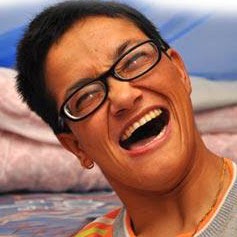 Jhamak Kumari Ghimire, born in July 1980 in Kachide village development of Dhankuta district is a Nepalese writer. She was born with severe disability that has prevented her from using her arms, and suffers from limited movement of her body and slurred speech called cerebral palsy and writes with her left foot. can hear but not speak and has limited eye sight. Ghimire also wears glasses because she has myopia, or nearsightedness. Her disability, however, hasn’t prevented her from expressing her acerbic, poetic humour freely ? through her left foot.Using her toes to write, she trod into the Nepali literature with the start of new millennium at the age of 19.Being deprived of an education didn’t stop her from learning how to read and write all by herself, and she has progressed so far along this path that she is today an award-winning author of 10 published books comprising both prose and poetry, mediums she traverses with equal,
heartfelt facility. In this chapter from Jiban Kanda Ki Phool, Jhamak describes the joy she felt when she first wrote the letter ‘ka’ in the dirt with a stick.In her autobiography, Ghimire documents instances such as her parents ignoring her desire to study or how she tried to memorize
the alphabets her younger sister was studying and practiced them by scribbling in the garden.
She learned to read and write using her feet and eventually launched an award-winning literary career. Ghimire promotes a message of self-sufficiency and empowerment for women.
 She has penned many anthologies of poems, stories and essays besides regularly contributing to newspapers as a columnist as She is columnist at the Kantipur newspaper.“Through her column, her potential has been acknowledged – nationally and internationally – not just because she can write with her feet, but because her writing is effective and efficient compared to the contemporary analytical litterateurs,” says Govinda Raj Bhattarai, a professor and writer who helped launch her book of autobiographical essays.
Her several feet-written interviews have been published by various media, one which helped launch her literary career.
In addition to working as a columnist, Ghimire has written about a dozen books in Nepali, including four collections of poems, a collection of essays, a collection of articles, an autobiography and two collections of stories that are currently on sale in the local market. She has won a number of national awards.She has won nearly a dozen national and regional literary awards since 1998, including one from the Nepali government.
 Despite being decorated with so many awards, Ghimire still considers the day her first book – a poetry collection – was published as the happiest day of her life.
Ghimire says that her earnings from her books have helped to support her family. But she says that because of patriarchal traditions, her family doesn’t like to acknowledge the financial contributions of their daughter.
“I want to tell all that this thought should be changed,” Ghimire says
“All our troubles are resolved if we remain self-dependent and self-sufficient.”-Jhamak Ghimire, writer
Now, Ghimire types her articles on the computer with her feet and can access the Internet for information.
She and others say her story shows this.
“In the past, I was a nuisance and a troublemaker for all, but the situation has changed today,” she says.
source:mynepal.com.np
Bhanubhakta Aacharya
 Bhanubhakta Acharya (Nepali: भानुभक्त आचार्य) (1814 AD – 1868 AD) The first poet of Nepal. He translated the great epic 'Ramayana' from Sanskrit to Nepali. Born to a Brahmin family in 1814 in Tanahu, he received at home an excellent education with a strong leaning towards religion from his grandfather.
Nepalese people commemorate 29th Asar as "Bhanu Jayanti" (usually on 13 July), the birthday of Bhanubhakta Acharya, who is also more popularly known as "Nepal ka Adikavi" (Nepal's first poet).
"Adikavi" in reference to Bhanubhakta had first been used by Motiram Bhatta. While writing a biography of Bhanubhakta in 1881 AD (1938 B.S), Motiram described him as Adikavi, not because he was the first poet in Nepali. As Motiram himself recognized, there were many poets before Bhanubhakta. Instead, he argued that Bhanubhakta deserved the title because he was the first poet who wrote with an understanding of the "marma"(inner essence) of poetry.
Bhanubhakta was a first Nepali poet who translated the great epic "Ramayana" from Sanskrit to Nepali. His writing was significant in the then Nepalese society where common people did not have access to this great epic. Only people belonging to Brahmin families were educated and could read and write Sanskrit. His translation of Ramayan in the Nepali language was a milestone in Nepali literature as it was written in a common language understood by all.
After the fall of the Khas Empire in the 15th century, its language which evolved into present-day Nepali was considered bastardized and limited to speech. Sanskrit dominated most of the written texts of South Asia and its influence was particularly strong in Nepal. Brahmins were the teachers, scholars and priests of the society by virtue of their caste. Their education was Sanskrit-oriented since most religious texts of the Hindu religion were in that language.
Many wrote poetry that was too heavily Sanskritized. Bhanubhakta was definitely "the" writer who gained the acceptance of a wide range of people and his creations played a key role in popularizing the written form of the Khas language.
Bhanubhakta's contribution was unique. Children who received an education at the time began their studies with light epics such as the "Ramayan" and graduated to the more complex "Upanishads" and "Vedas." Ram's heroic exploits were highly impressive to Bhanubhakta, so he decided to make the deity more accessible to the people who spoke Khas. (Since the social order did not encourage literacy, most country people did not understand anything when epics were read out to them in Sanskrit.)
When completed, his translation of the Ramayan was so lyrical that it was more like a song than a poem.
Bhanubhakta did not study Western literature. All his ideas and experiences were derived from his native land. This lent such a strong Nepali flavour to his writing that few poets have been able to equal his simple creations in terms of content: a sense of religion, a sense of simplicity, and the warmth of his country are the strongest features of his poetry. Those who read the first lines of the Bhanubhakta Ramayan can clearly feel Nepal in them.
Bhanubhakta was a young boy from a wealthy family and was leading an unremarkable life until he met a grass cutter who wanted to give something to society so that he could be remembered after death too. After listening to the grass cutter Bhanubhakta felt ashamed of himself. So by the inspiring words of the grass cutter, he wrote these lines:
He gives his life to cutting grass and earns little money, he hopes to make a well for his people so he will be remembered after death, this high thinking grass cutter lives in poverty, I have achieved nothing, though I have much wealth. I have neither made rest houses nor a well, all my riches are inside my house. This grass cutter has opened my eyes today, my life is worthless if the memory of my existence fades away.
Bhanubhakta wrote two masterpieces in his life. One, obviously, is the "Bhanubhaktey Ramayan" and the other is a letter he wrote in verse form to the prime minister while in prison. Due to some misunderstanding in signing the papers, he was made a scapegoat and put into prison. His health became bad and he was given false hopes of being set free. For a long time, his case was not even heard. So he wrote a petition to the all-powerful prime minister requesting his freedom.
Every day I see kind authorities and they get rid of my worries. I am at peace and at night I watch dances for free. I do what my friends - mosquitoes, fleas, and bedbugs - say: the mosquitoes sing and the ticks dance, I watch their play. I was jobless, wealth-less, my hard-earned food came from the spade, I served those people so everyone would notice me and give me respect. Without wavering I served and they were pleased and they gave overflowing attention that is never, ever, taken away. I am 40, I have a son who is eight years old. The time for celebrating his manhood-ceremony is close. I am rotting inside these four walls, so what can I do, my Lord? How can I complete the ceremony in this darkness-filled world? The secret of success should be given by the father, the lessons of life should be given by the mother, my child has yet to study the Vedas and serve his teacher, therefore to you, my Owner, I repeat my prayer. Even while a great ruler like you own this earth, a Brahmin's rituals of manhood are being delayed. Whose feet do I have to place my sorrow at except yours? Please take pity on me and decide my case for better or worse. My body is weak, it is made of grain and water. How shall I say what has befallen me here? I have suffered much sorrow, my body grows heavy, and I have been ill for many days. I was imprisoned for a long time at Kumarichowk, illness came upon me there and after much trouble, I went home. When I became well they brought me here, now you, my Owner, you are my only hope. Whatever I explained to the authorities in writing is true. But others' answers and written proofs, I am told, have proved wrong all that I have said. I told them I would pay their fines a thousand-fold. But they say they have signatures on papers and letters, they say their witnesses have many more tales. I said I would not plead, I would rather be false, I will say anything that gets me outside these walls. I have no wish to spend the rest of my life in this quarrel. I have no wish to become a millionaire and fill my house with treasures. Days pass by uselessly and I cannot comfort myself if you would decide my case it would be a great help. I have talked with the warden and he does not speak. Even if he does, his: "tomorrow, tomorrow," sounds like a joke. What are these tomorrows? It would be better to know I won't be freed. Many tomorrows passed. Please fill this empty bag of mine, I beg.
Bhanubhakta not only won his freedom with his poem but was given a bag of money as well. So passed the most dangerous and exciting time of his life. He died in 1868 as a simple man who did not know he would be among the most revered poets of Nepal. Perhaps, it is only he and Laxmi Prasad Devkota that have become literary gods in this country. The only difference between the two is that Devkota's works continue to enjoy as much celebrity as the great poet himself, while Bhanubhakta's fame tends to overshadow his writings.
However, his creation was not published and he was to die without receiving credit for his contribution. It was in 1887 that Moti Ram Bhatta found his manuscript and printed it in Benaras, India. Bhanubhakta Acharya is considered the first poet writing in the Nepali language. Poets before him in Nepal usually wrote in Sanskrit. One of his writings is well known for its colourful, flowing praise of Kathmandu valley and its inhabitants. But he has been a lost identity. His works are not as famous as other poets in Nepal's history of literature
source:Wikipedia
Bishweshwar Prasad Koirala
 Bisheshwar Prasad Koirala was born on September 8, 1914 in Banaras, India. He was the second son of Krishna Prasad Koirala who was a leading businessman in Biratnagar. In the beginning, the family was well off but due to the resentment of the then Rana Prime Minister Chandra Shumshere Rana, the family's property in Biratnagar was confiscated. The entire Koirala clan, altogether 45 members, were forced to live in exile in Banaras, India. Since none of them had a job, it was a difficult start.
Benaras proved expensive and they moved to Saharsa District in Bihar. Gradually their financial condition improved. Until he was 14 years old, B.P. studied in a school established by his father; afterwards he joined Harischandra School in the city. He began writing from the ninth grade and his writings started to get published in Indian papers. About this time, he came in contact with reputed Indian writer Sahityakar Munsi Prem Chand. Prem Chand, whom B.P. considered his mentor, taught the young writer the basics of writing. He edited B.P.'s work and published his first story in an established paper called Hans. After this, B.P.'s other stories were published in a well-known paper called Bishal Bharat and in this way, he received a lot of inspiration and encouragement from writers such as Prem Chand, critic Shantipriya Duvedi, and Banarasidas Chaturbedi.
B.P. was also attracted to politics from an early age. As a young student, he was involved in the fight against the British regime in India. Later on, he fought against the Rana regime in Nepal and after its overthrow, he was appointed the first prime minister of Nepal. B.P. was also against the Panchayat system. For this, he was jailed for eight years at Sundarijal. During this time, he wrote some of his best works. In time, his political beliefs grew strong and he passionately wanted to give Nepal a new vision. Through his political activities, he met Mahatma Gandhi, Jawahar Lal Nehru, King Tribhuwan, King Mahendra, King Birendra, and Mao Sedong among others.
 In 1930, the British Raj charged him and his brother Matrika Prasad Koirala for having contacts with terrorists. They were arrested and set free after three months. Due to this, his father wanted B.P. to study in Calcutta at Scottish Church College. Krishna Prasad Koirala also felt that his son would receive better opportunities in a big city. B.P. unwillingly joined the college because personally he felt that the city was too big and far away from home. Towards the end of 1930, he left the college and returned to Banaras. In 1932, he completed his intermediate level of studies. His father again insisted that his son join Scottish Church College in Calcultta. So for the second time, B.P. joined the college but left it soon after. In 1934, he completed his bachelor's degree in economics and politics from Banaras Hindu University.
Meanwhile, Chandra Shumshere Rana died and B.P.'s father returned to Nepal. B.P. joined Law College in Calcutta for his postgraduate studies. Around this time, he married Sushila Koirala.
In 1939, B.P.'s first story in Nepali "Indrabadan" was published in a monthly paper Sharada. The story immediately gripped the attention of many people and sent shockwaves throughout the literary circle of Nepal. The story was experimental, unconventional and unlike most previous Nepali stories that are based on myths and are symbolic, "Indrabadan" addressed issues that are still taboo in Nepalese society. It also has psychological and experimental aspects to it. Koirala often said that his writings were heavily influenced by the works of Sigmoid Freud. Most of his writings feature Nepalese women as the protagonists and one can read about their personal experiences. His important works are "Doshi Chasma", "Sumnima", "Tin Ghumti", "Narendra Dai", "Modi Ain", "Hitler Ra Yahudi", and "Babu-Aama-Ra-Chora".
During his stay in Banaras and later on in life, B.P. read a lot and enjoyed the works of Anton Chekov, Andre Gid, Charles Dickens, Robert Browning, Keats, Wordsworth, Hemmingway, Rabindranath Tagore, and others. He used to say that his style was influenced by the Russian writer Anton Chekov. He felt that Tolstoy was the greatest literary personality of the world and considered Bal Krishna Sama and Laxmi Prasad Devkota as the great writers of Nepal.
An interesting aspect of B.P.'s works is that one does not find politics influencing his writings. Although a passionate politician - he was bound to conventional rules and norms of society - he hardly wrote about the constraints of his real life. It seems B.P. was able to place his feet in two different boats and bring both of them successfully to the bank. He once said: "I am one person in politics and a completely different person in literature. In this way, I feel that the two persons inside me are doing two different things and that they have never met. Politics has never influenced my writing." B.P. suffered from throat cancer and died in 1982 in Kathmandu.
credit:spinybabbler
Diamond Shumsher Rana

Born to the aristocratic Rana family in Palpa, in 1917, Diamond Sumsher Rana was on the high rank of the Nepal Army at the age of 20. Despite being a Rana himself, he loathed the Rana rulers. He was an advocate of the people and democracy. His decision to quit the guns and pick up the pen earned him the recognition as the first important historical novelist. He was the first author to survive solely on the royalty of his novels. He died at the age of 94 in 2011.
Life and career
He was born at Tansen Durbar in Palpa, where his grandfather, Sher Shumsher Jung Bahadur Rana, was governor. His father Buddha Shumsher Jung Bahadur Rana was a colonel in the Royal Nepal Army. Rana enjoyed a privileged upbringing and was a captain in the Royal Nepal Army.

In 1948 Rana travelled to Benaras, India and had his first novel Basanti published. In Nepal, he had aligned himself with an anti-establishment faction of the Rana regime and was arrested, court-martialled and sentenced to death but was later freed after members of the Rana family pressured the regime for his release Rana later joined the political opposition and was a member of the Nepali Congress Party from 1954 to 1987.
source:wikipedia
About
,
Author
,
Diamond Shumsher
,
Writer
Subscribe to:
Posts
(
Atom
)


